



If you bought your home through the shared ownership scheme, there’s a decent chance nobody explained what happens when your fixed rate comes to an end or you want to remortgage before then.
Here’s the good news: a remortgage for shared ownership is done thousands of times a year and in most respects it works exactly like any other remortgage.
Here’s the less good news: doing nothing is expensive. Anyone who drifts off their deal lands on their lender’s Standard Variable Rate. In July 2026 the average SVR sat at 7.13%, against average two- and five-year fixed rates of roughly 5.6% (Moneyfacts). On a £120,000 mortgage, that gap is well over £100 a month for doing precisely nothing.
However, since you’re reading this, we’ll assume you’re preparing to remortgage, so here’s everything you need to know to do so…
Can you remortgage a shared ownership property?
Yes. You can absolutely arrange a remortgage for shared ownership, either by switching to a brand new lender or by moving to a new deal with your existing one (a process called a product transfer).
The single thing that trips people up is that your mortgage is secured against the share you own, not the whole property.
If your home is worth £300,000 and you own 40%, your slice is £120,000. Every calculation a lender makes (loan to value, affordability, how much extra you can borrow) is based on that £120,000, not the £300,000.
The second thing is that your housing association (or local council, or registered provider) holds a legal interest in the property. They need to be told about your plans and they need to consent. This is routine and rarely refused, but it does add time and a small admin fee.
The third thing is choice. Not every lender will touch shared ownership. That’s the honest answer, so it’s important to work with a broker who knows which will…
Get in contact today, and one of our specialist shared ownership mortgage brokers will talk you through your options.
If you’d like to learn more about remortgaging, you can download our completely free guide to remortgaging.
Why do people remortgage their shared ownership property?
Remortgaging isn’t a one-size-fits-all type of thing. There are many reasons someone might remortgage their shared ownership property, including:
Your fixed rate is ending
This is the big one, and it’s the reason most people remortgage and consequently find this page.
You can secure a new deal up to six months before your current one ends, and lock the rate in now to start the day your existing product expires. This prevents you from ending up on your lender’s standard variable rate (SVR), which could cost you a lot more money.
Six months is the sweet spot as it’s the earliest you can secure your next mortgage deal. By locking in a rate at this point, you’ll be guaranteed that rate even if interest rates rise before your current deal ends. If rates fall instead, you can simply switch to the lower rate before completion, giving you the opportunity to save even more.
Start the remortgage process later, say, six weeks out, and you’re rushing a process that, on shared ownership, genuinely takes longer than a standard case, meaning you could end up on the SVR for a short period of time.
Remortgage to staircase
Staircasing is the other headline reason many people search for a remortgage for shared ownership.
In case you weren’t aware, staircasing is buying more of your own home, and a remortgage is the best time to do it.
The reason being is the paperwork, legal fees, and other logistics are already being sorted for your remortgage, so adding the staircasing process into the mix can save you time, hassle, and potentially some costs too.
We’ve outlined what this process looks like below.
Home improvements
Many homeowners would love to update their kitchen or bathroom, install solar panels, or spruce up their garden, but simply don’t have the funds to make those improvements.
Well, remortgaging can help you secure those funds.
You can raise money against your share of the home to release funds that you can use to make home improvements, and it’s the reason housing associations are most likely to consent to additional borrowing.
However, there are two key things you need to check first:
- If you bought under the new model (homes funded through the Affordable Homes Programme 2021-26), you may have an initial repair period of up to 10 years, during which your landlord contributes towards certain essential repairs.
- Structural alterations will usually need your landlord’s written permission regardless of how you’re funding them.
Releasing equity will increase the amount you borrow and could lead to higher monthly repayments or more interest being paid over the life of the mortgage. It’s therefore important to consider carefully how the funds will be used and whether the long-term cost is worthwhile.

Debt consolidation
If rising living costs have eaten into your savings and you’ve found yourself relying on credit cards or other forms of borrowing, remortgaging could help you regain control of your finances.
By consolidating existing debts into your mortgage, you can replace multiple monthly payments with a single, more manageable repayment. Because mortgage rates are often lower than those charged on credit cards and personal loans, this can help reduce your monthly outgoings and ease pressure on your budget.
However, this isn’t so simple when it comes to remortgaging a shared ownership property.
Many shared ownership lenders and housing associations restrict capital raising for debt consolidation, or even ban it outright. Others will consider it but cap the loan to share ratio, and even then your housing association may only consent to additional borrowing for staircasing or improvements.
This doesn’t mean it’s impossible to consolidate your debts, it just means the route has to be chosen carefully and sometimes a second charge or a straightforward budgeting conversation is the better answer.
Changing your term, or your life
Extending the term to reduce monthly payments. Shortening it because you’ve had a pay rise. Adding a partner. Removing an ex. Moving from interest-only to repayment. All of these are legitimate reasons to review, and all of them are easier to handle at remortgage time than mid-deal.
How lenders assess a shared ownership remortgage application
Your remortgage application will look familiar to your initial mortgage application (income, outgoings, credit score, valuation) but there are three extra pressure points you need to be aware of.
Your rent counts against you
Lenders treat the rent on the landlord’s share as a committed monthly expenditure. Some go further and stress-test it upwards, because shared ownership rent is typically reviewed annually and linked to inflation.
This is the most common reason a shared ownership case that “should” work doesn’t. If your rent has climbed for three or four years running while your salary stood still, your borrowing capacity has quietly shrunk even though your equity has grown.
Service charges get scrutinised
Lenders factor service charges into affordability. A big jump, common in newer blocks, can materially change what you can borrow.
Lease length matters more than you think
Shared ownership homes are always leasehold.
Newer homes under the current model come with 990-year leases, but plenty of older shared ownership properties were sold with 99 or 125-year terms.
Once a lease drops below 90 years remaining, many lenders will ask you to extend the lease before they offer a new mortgage. Some may even refuse to lend at all on short leases.
Practical takeaway: check your remaining lease term before you do anything else. If it’s under 90 years, that conversation needs to happen now, not at your next remortgage.
Product transfer, remortgage, or further advance?
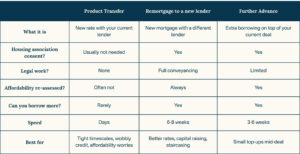
How to remortgage a shared ownership property
Remortgaging a shared ownership home follows the same broad path as any other remortgage, but with a few extra turns. You’re dealing with a housing association as well as a lender, and a much smaller pool of lenders willing to take it on. Here’s how it works, step by step.
1. Review your current mortgage
Dig out your existing deal and check the balance, the rate, when your fixed period ends and whether early repayment charges apply.
If you’re looking to remortgage early, the exit fee may outweigh the saving you’re looking to make.
2. Decide what you want out of it
A lower rate? Extra borrowing for home improvements? Or are you looking at buying a bigger share of your home? Your goal shapes everything that follows, including which lenders will consider you.
3. Work out your equity
Know exactly what percentage you own and what it’s worth today. If your property has gone up in value, you may have more equity than you think, which can open up better rates or make staircasing more affordable.
To work out your equity subtract the outstanding mortgage balance from the current market value of your home.
4. Speak to a specialist advisor
This is the step that matters most. Only a handful of lenders offer remortgages for shared ownership properties, and their criteria vary widely.
A specialist advisor knows which ones will consider your circumstances and can compare deals across the market rather than the handful you’d find on a comparison site.
Get in contact today, and one of our specialist shared ownership mortgage brokers will talk you through your options.

5. Compare your lender options
Your advisor will match your share size, income and plans against each lender’s criteria, then narrow it to the deals you’re genuinely likely to get, not just the headline rates.
6. Check affordability
Lenders assess your income, outgoings and credit history, and factor in your rent and service charge alongside the mortgage payment. Getting a clear picture early avoids surprises later.
7. Submit your application
Payslips, bank statements, ID and details of your lease. Your advisor will tell you exactly what’s needed and handle the submission.
8. Complete the legal work
A solicitor reviews your lease, liaises with your housing association and handles the transfer to your new lender. Most shared ownership remortgages complete within four to eight weeks.
Remortgaging to staircase: How it works
Staircasing is one of the main reasons shared ownership homeowners look to remortgage. Even if it isn’t the reason you’re remortgaging right now, it could well be in the future, so it’s worth understanding how it works.
1. The RICS valuation
Your housing association will require an independent RICS “Red Book” valuation to set the price of the extra share. Crucially, these are usually only valid for three months. If your mortgage takes longer than that to complete, you may have to pay for a fresh valuation.
This is the single most common way staircasing goes sideways. Sequence the valuation and the mortgage application so they land together.
2. How much can you buy?
If you bought under the new model (most homes funded through the Affordable Homes Programme 2021-26), you can staircase in increments as small as 1%, typically for the first 15 years, and the landlord covers valuation costs on those small purchases.
Meanwhile, older leases usually set a minimum of 10% per instalment, so it’s important to check yours.
Note that Older Persons Shared Ownership works differently as staircasing is capped at 75%, at which point rent stops being payable.
3. The stamp duty trap nobody mentions
When you originally bought, you either:
- Made a market value election: paying SDLT upfront on the full property value, meaning no further stamp duty is ever due on staircasing; or
- Paid SDLT on your initial share only, in which case no further SDLT is due until your total ownership exceeds 80%, at which point a bill lands.
If you’re staircasing from, say, 60% to 100%, and you didn’t make a market value election, budget for stamp duty.
If you’re unsure which election was made, you should ask your conveyancer as it will be in your original paperwork.
What a shared ownership remortgage costs
Here’s a quick look at the typical costs that come with remortgaging your shared ownership property:
- Lender arrangement fee (£0 – £2000)
- Valuation fee (£0 – £500+; frequently free on remortgage deals)
- RICS Red Book Valuation (£250 – £600; only applies when staircasing)
- Legal fees (£500 – £1500)
- Housing association admin/consent fee (£50 – £300)
- Broker fee (we charge £299 only once the mortgage has been offered)
- Early repayment charge (1% – 5% of existing balance; only if you’re leaving your current deal early)
These costs are intended as rough estimates. The amount you pay may be higher or lower depending on your individual circumstances.
Early repayment charges
An early repayment charge is the penalty for exiting your deal before it ends. It’s usually a percentage of your outstanding balance, often tapering (5% in year one down to 1% in year five is a common shape).
To put that in perspective: if you have an outstanding balance of £200,000 and you’re in year two of your deal, a 2% ERC would cost you £4,000. We obviously don’t need to tell you that that’s a pretty big sum. and one that needs to be weighed carefully against any savings you’d make by switching.
But let’s say switching to a new deal saves you £200 per month in interest. You’d recoup that £4,000 in exactly 20 months, meaning if you have more than that left on your deal, it could well be worth switching.
How long does a remortgage for shared ownership take?
We’d say you should budget six to eight weeks from application to completion, versus around four weeks for a standard residential remortgage.
Shared ownership remortgages take this bit longer purely because of the additional consent and conveyancing work, which is unfortunately outside everyone’s control.
What if my situation has changed?
Your credit has taken a knock
Missed payments, defaults or a CCJ narrow the field but don’t close it.
Fortunately, plenty of specialist lenders exist precisely for borrowers who don’t fit high street templates when it comes to credit; however, expect a higher rate and a bigger deposit requirement on the share if staircasing.
If the credit event is recent, a product transfer with your existing lender is often the smart holding move as no new credit assessment will be required.
Affordability no longer works
Rising rent, rising service charges, a new car finance agreement, a baby. Any of these can shrink your borrowing capacity.
Options include extending the term, a product transfer (where affordability won’t be assessed), waiting for the rent review cycle, or in some cases a joint borrower sole proprietor arrangement.
You’ve gone self-employed
You’ve gone self-employed for the freedom and opportunity to earn more money; however, you’ve now probably been told that getting a mortgage is impossible.
Well, it’s not. Sure, there’s a few extra hoops to jump through with self-employed mortgages, but that doesn’t stop you from remortgaging.
Self-employed applications differ in two ways: the documents required, and how income is calculated.
On documents, you’ll need everything an employed applicant provides, plus two or more years of certified accounts and SA302 forms or an HMRC tax year overview covering the last two to three years.
On income, lenders look at net profit rather than earnings. For sole traders, most will average net profit across the past two to three years.
Shared ownership plus self-employment narrows the list of lenders available meaningfully, which is exactly the scenario where a broker with the right lender relationships saves you weeks of dead ends.
Ready to see what’s available to you?
Two people with identical properties and identical balances can get completely different outcomes depending on their rent, their lease, their service charge, their credit file, and which lender’s criteria happens to fit.
That’s a frustrating thing to work out alone on a comparison site.
Alternatively, you could get a remortgage advisor who knows the market inside out to sort everything for you.
At The Levels Financial, we’ll look at your current deal, your share, and your goals and secure you the remortgage that works for you.
Get in touch today for a free, quick initial chat.
Your home may be repossessed if you don’t keep up repayments on your mortgage.
There may be a fee for mortgage advice. The actual amount you pay will depend on your circumstances. The fee is up to 1%, but a typical fee is 0.3% of the amount borrowed.